Case study: CFC charging racks compared to cast racks

Less is more - lightness that packs a punch

In the automotive industry, case hardening is a standard process for permanently increasing the wear and fatigue resistance of drive components. At the same time, heat treatment companies are under high pressure: delivery deadlines must be met despite full capacity utilization, ideally without investing in new equipment. In practice, it is often not the furnace itself that is limiting, but the charge: weight limits, packing density, handling and process stability determine how many parts can actually be treated per furnace run.

Share case study:

LinkedIn

Background

In case hardening, steel components are first “carburized” in a carbon-containing atmosphere and then quenched. In this case study, the treatment was carried out in a multi-purpose chamber furnace using gas carburizing with nitrogen quenching.

Overview

Industry:

Automotive industry/ contract heat treatment

Procedure:

Case hardening

Solution:

Development and use of a lightweight, robust CFC frame

Services:

Result:

  • Significantly higher number of components per oven run
  • Minimized dead weight due to lower dead weight
  • Easier handling due to lower weight
  • Easy integration into existing oven system possible

The challenge

Prior to our collaboration, many of our customers worked with heavy cast charging systems. The problem: The number of components per batch is often not sufficient to achieve long-term, economic goals. The bottleneck lies in the “dead weight” of the racks: the heavier the carrier system, the fewer components can travel within the batch weight specified and limited by the furnace manufacturer per run. At the same time, workpiece carriers must be robust and function reliably.

The specific task

The aim is to treat more components per oven run without converting the oven system or exceeding the limited batch weight of the system. This requires a charging rack that:

  • enables a higher packing density (parts per layer/batch)
  • can be integrated into the existing infrastructure (loading/unloading bays, transportation)
  • can be operated reliably
  • has a long service life
  • and is safe to handle

The implementation

A customized workpiece carrier system is designed for the customer based on the specified framework conditions, such as oven parameters, installation space and placement specifications.

Depending on the temperature and process gases, the engineering selects the material. In the design process, the frame is adapted to the furnace parameters and the expected influences on the frame are simulated using FEM analyses.
This results in the final design of the CFC frame, which is then used in production. production produced by Graphite Materials and delivered to the customer fully assembled.

Process results

By switching from cast iron frames to CFC frames the number of pieces per batch can now be significantly increased with the same oven capacity. At the same time, the noticeably lower frame weight makes handling easier and safer for production staff.

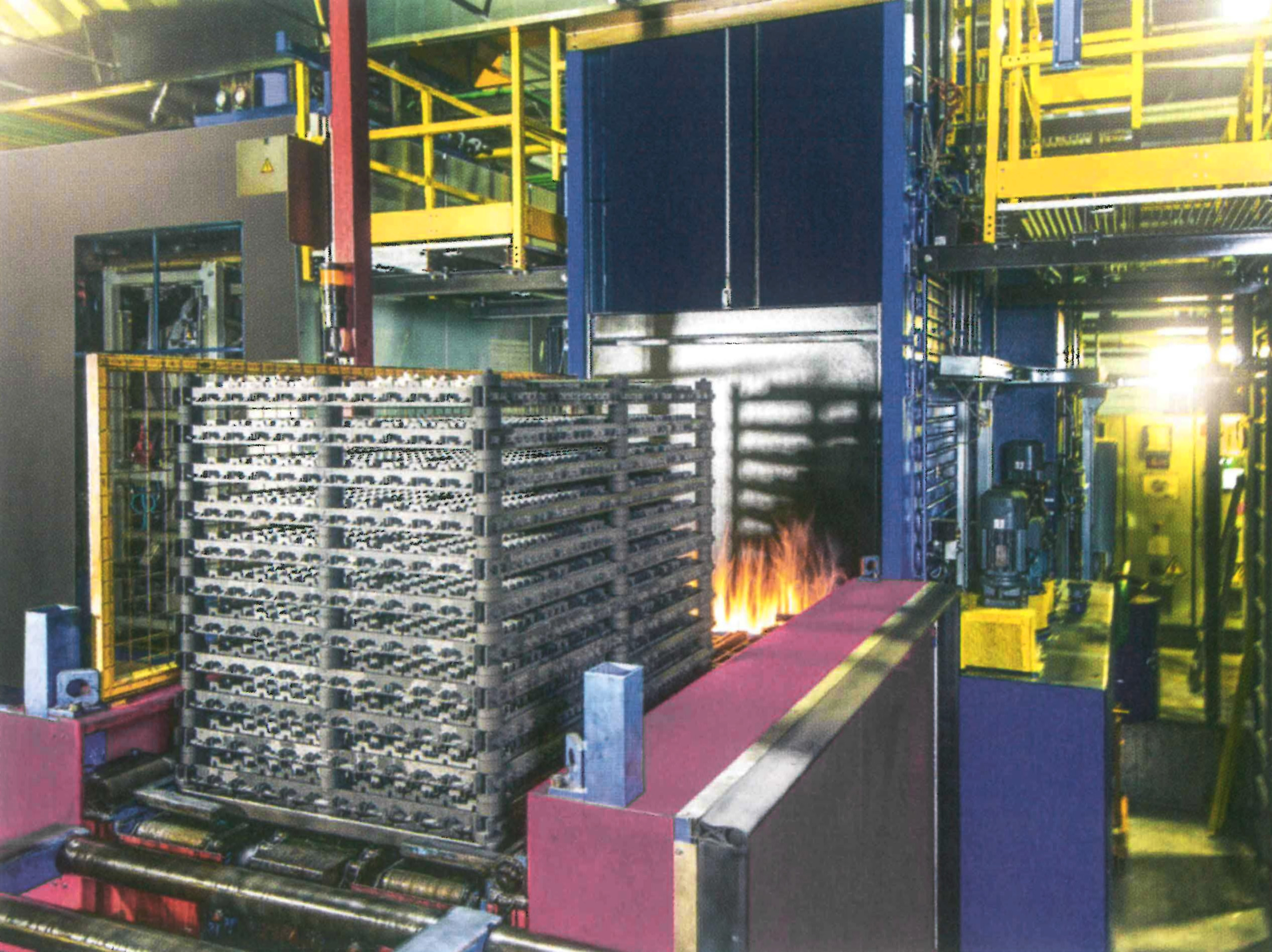
Production batch of CFC workpiece carriers (Source: HEAT Holding)

The result

One of our customers has demonstrably achieved the following results by switching from cast iron to CFC frames:

  • Batch quantity increased by 87%: from 2,304 to 4,312 parts per batch
  • Frame mass reduced by 62%: from 633 kg (cast iron) to 240 kg (CFC) – 393 kg less dead weight.
  • More component mass usable in the oven: part mass per batch from 640 kg to 1,199 kg (+559 kg).
  • Weight limit better utilized: loaded batch 1,440 kg (CFC) vs. 1,274 kg (cast iron) at max. 1,500 kg.
  • Capacity gain in the order: Total process time for the target quantity (example: 5 million units) reduced by 50% (to 14,000 h).
  • Better handling & occupational safety: significantly less physical strain, higher employee acceptance; loading/unloading is faster and easier to standardize.
  • Proven in practice: System proven in use after 8 months / approx. 200 oven runs; damaged elements could be replaced if necessary and the function fully restored.

Your contact