Case study: Carbide recycling

Precisely sealed - cleanly recycled

In the carbide industry, valuable materials such as tungsten carbide and cobalt are used, for example, in indexable inserts, drills and milling cutters. These raw materials are expensive, sometimes scarce and only available in a few regions. The recycling of used carbide products is therefore becoming increasingly important.

Share case study:

LinkedIn

Background

A tried and tested process is the so-called thermal zinc process: In this process, hard metal scrap is heated together with zinc in a furnace heated in a furnace. The zinc diffuses into the cobalt binder, causing the carbide to break up and disintegrate into a porous, easily crushable mass. After the zinc has evaporated, a powder structure remains, which serves as the starting point for new hard metal products.

Overview

Industry:

Carbide industry / toolmaking / raw material recycling / powder metallurgy

Procedure:

Thermal zinc process for the recovery of tungsten carbide and cobalt powders

Solution:

Development and short-term implementation of a sealing concept between crucible and connector using temperature-resistant soft felt.

Services:

  • Technical advice and analysis by our engineering
  • Development of a customized soft felt sealing concept
  • Material selection for high temperature and media resistance
  • Fast implementation without system conversion

Result:

Increased process reliability, reduced zinc loss, less stress on system components and longer service life with a short project duration

The challenge

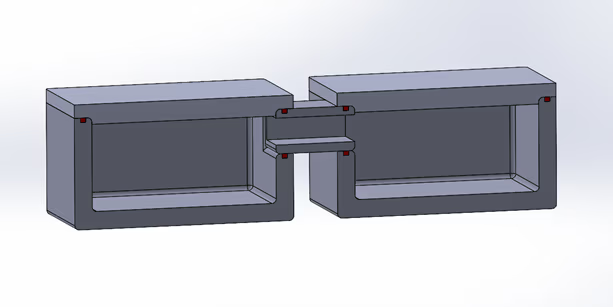
In one customer’s process, two separate crucibles are used, which are coupled together via a hollow connector. One contains the zinc, the other the hard metal scrap. The weak point of the system was at the transitions between the crucibles. crucibles and the connector: Zinc vapor could escape uncontrolled, with negative consequences for process reliability, material yield and system components.
The existing design did not allow for a permanent seal. A reliable, easy-to-implement solution was needed at short notice and without system conversion.

The specific task

The aim was to create a functioning seal between the connector and the crucible without changing the existing system. The requirements were:

  • High temperature resistance
  • Chemical resistance to zinc vapor
  • Simple integration
  • Short-term feasibility

Graphite Materials impressed with its fast and non-binding consultation and developed a suitable concept based on a temperature-resistant soft felt within a few days. soft feltwhich was flexibly adapted to the geometry and inserted into the transition area.

Process results

By using the soft felt seal, it was possible to significantly improve the sealing of the system. Based on the process parameters and component geometry, a simple but highly effective solution was developed that not only reduces zinc loss but also extends the service life of the system components.

Soft felt seals (red) on the crucibles

The result

  • Increased process reliability thanks to stable sealing
  • Reduced material loss due to minimized zinc vapour leakage
  • Less stress on the components, resulting in longer service life
  • Fast implementation: from idea to solution in just 4 weeks
  • No conversion necessary, existing system remains unchanged
  • High flexibility of the solution thanks to soft felt material
    Satisfied customer thanks to proactive advice and short response time

Your contact