Case study: Insulation cylinders for pressure sintering systems
Stable process at high pressure - a cylinder that can withstand anything
In pressure sintering systems, components are compacted under high pressure and under demanding thermal conditions. Consistent product quality can only be guaranteed if the heat distribution in the chamber is uniform and all graphite components can withstand the highest loads.
Share case study:
LinkedIn
Background
Pressure sintering technology plays a central role in toolmaking as well as in mechanical and plant engineering. For example, indexable inserts and carbide drills are manufactured in toolmaking, while gear wheels, hydraulic components and non-porous structural parts are produced in mechanical engineering.
The process requires pressures of 60 to 100 bar and temperatures of up to 1500 °C, and the debinding and sintering processes often have to take place in the same chamber. A uniform gas flow and temperature homogeneity are crucial in order to achieve high-quality results.
In addition, companies face challenges such as high energy requirements, limited life cycles for system components and increasing demands for sustainability and resource efficiency.
Overview
Industry:
Toolmaking, carbide industry, mechanical and plant engineering
Procedure:
Pressure sintering under high pressure (60-100 bar) and high temperatures up to over 1500 °C
Solution:
Development of a large-format, one-piece insulation cylinder for pressure sintering systems
Process stability, process reliability and long product service life thanks to reliably tight insulation in large and one-piece cylinder design in sandwich construction.
The challenge
High-temperature processes in pressure sintering systems require an insulation cylinder that remains permanently stable and gas-tight, even with extreme pressure and temperature changes. This means the highest demands on the insulation properties of the cylinder to ensure safe and reproducible processes.
For a long time, it was also a particular challenge for the pressure sintering industry to procure large, one-piece insulation cylinders. It is not uncommon for the industry to require insulation systems over 3 meters in length. Only a few manufacturers worldwide were able to produce one-piece cylinders of this size.
The specific task: development of a large-format insulation cylinder
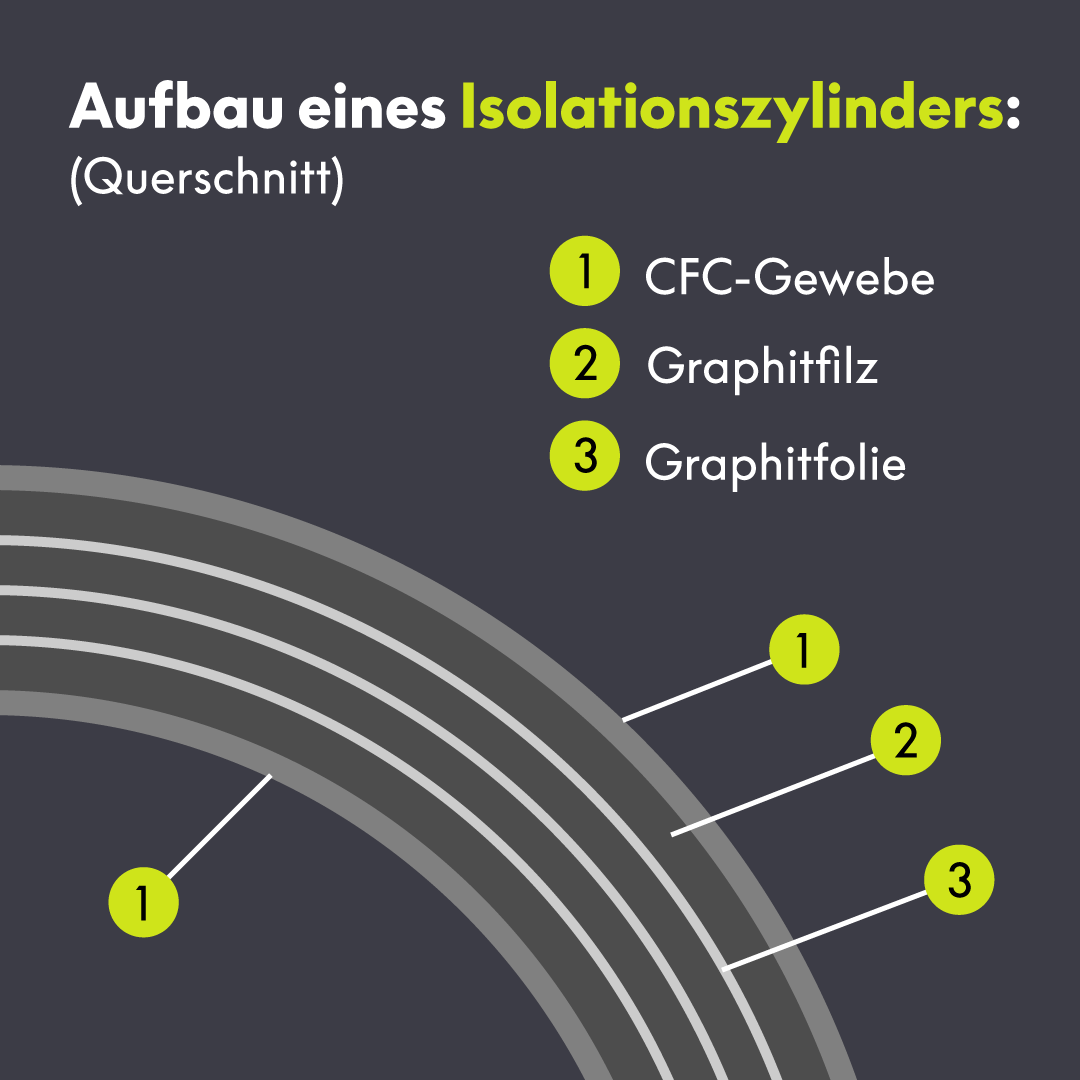
Graphite Materials took the initiative and, together with a business partner, developed an insulation cylinder in sandwich construction that was specially tailored to the application.
One-piece production in a previously unavailable size of over 3 meters in length
Optimum insulation properties thanks to the symbiosis of different insulation materials in sandwich construction
Long service life thanks to effective edge and surface protection
Cost advantage due to reduced maintenance intervals
Testing of the prototype was successful and the cylinder met all mechanical and thermal requirements.
Process results
Thanks to the new development, the temperature distribution in the pressure sintering process has been made more homogeneous, which enables consistent product quality. At the same time, the new design significantly extends the service life of the insulation components and reduces maintenance costs.
The result
One-piece large version with a length of over 3 meters possible
Guaranteed gas-tight insulation thanks to optimum material composition
High process reliability thanks to longer service life and low wear
Stable process conditions thanks to uniform temperature distribution
Shorter delivery times thanks to optimized production concept